
Whisper made robust ASR feel obvious. Local products made the tradeoffs visible.
Whisper is the model that taught a lot of builders what modern speech-to-text could feel like: multilingual, robust, and open enough to run locally. The next question is when Whisper is the right model for the job.
Whisper became the default mental model for modern ASR because it was easy to try, surprisingly robust, multilingual, and backed by a large weakly supervised training recipe.
That does not mean Whisper is always the right local model. For Muesli, Whisper is one part of the model bench: excellent for robustness and language coverage, but worth comparing against faster local English paths such as Parakeet when dictation latency matters.
What should I know about Whisper?
Maker
Whisper was released by OpenAI as an open-source speech recognition and translation model family.
Training idea
The Whisper paper describes large-scale weak supervision across hundreds of thousands of hours of multilingual and multitask audio data.
Architecture
Whisper uses an encoder-decoder Transformer: audio features are encoded, then text is decoded autoregressively.
Strength
Robust multilingual transcription and translation made Whisper a strong default for many developers.
Tradeoff
Autoregressive decoding and larger model sizes can add latency, especially for short dictation.
Muesli view
Whisper is useful, but model choice should fit the workflow: dictation, meetings, language, accuracy, and latency are different jobs.
What is OpenAI Whisper?
Whisper is an automatic speech recognition model family from OpenAI. It can transcribe speech and, for some workflows, translate speech into English. Its popularity came from a rare combination: good results, open weights, broad language coverage, and a simple developer experience.
For users, Whisper made ASR feel less like a fragile enterprise API and more like a model you could actually run, test, and build around.
How does Whisper speech-to-text work?
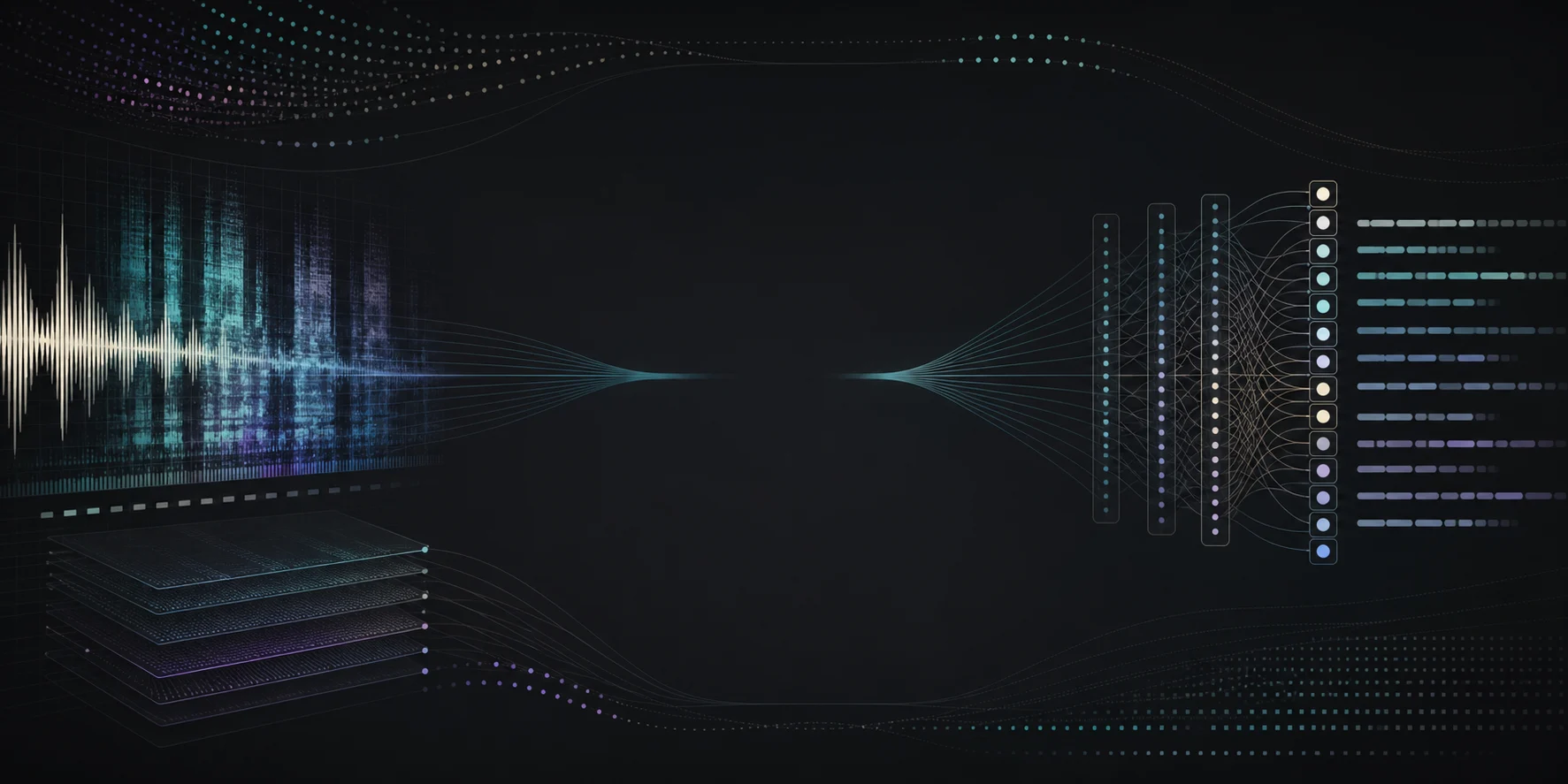
Whisper is an encoder-decoder Transformer. Audio is converted into log-mel spectrogram features, the encoder builds a representation of that audio, and the decoder generates text tokens autoregressively.
That architecture is powerful because it can model transcription as a sequence task with language context. The tradeoff is that decoding can be heavier than more direct ASR approaches, especially when the user expects instant short-form dictation.
Where does Whisper fit among speech-to-text models?
Can Whisper run locally on Mac?
Yes. Whisper can run locally through different runtimes and model sizes, including CoreML-friendly paths. The practical question is which size and runtime fit your workload.
For a long recording, a slower but robust model may be fine. For hold-to-talk dictation, the model has to feel immediate. That is why Muesli treats Whisper as one local option rather than the only serious answer.
Should I use Whisper or Parakeet for local STT?
Use Whisper when robustness, multilingual behavior, and a familiar open ASR baseline matter. Use Parakeet when fast local English transcription is the sharper wedge.
The bigger point is that model choice should be explicit. A serious speech-to-text app should let the workflow pick the model, not force every sentence through one default just because it is famous.
Where should I go next?
Common ASR architectures
Why Whisper’s encoder-decoder design differs from CTC, RNN-T, TDT, and Conformer-heavy systems.
NVIDIA Parakeet speech-to-text
The local English ASR model family that makes fast dictation feel practical.
Local speech-to-text glossary
Definitions for ASR, log-mel features, VAD, diarization, AEC, and local inference.
Offline dictation for Mac
How local models such as Whisper fit into real Mac dictation workflows.